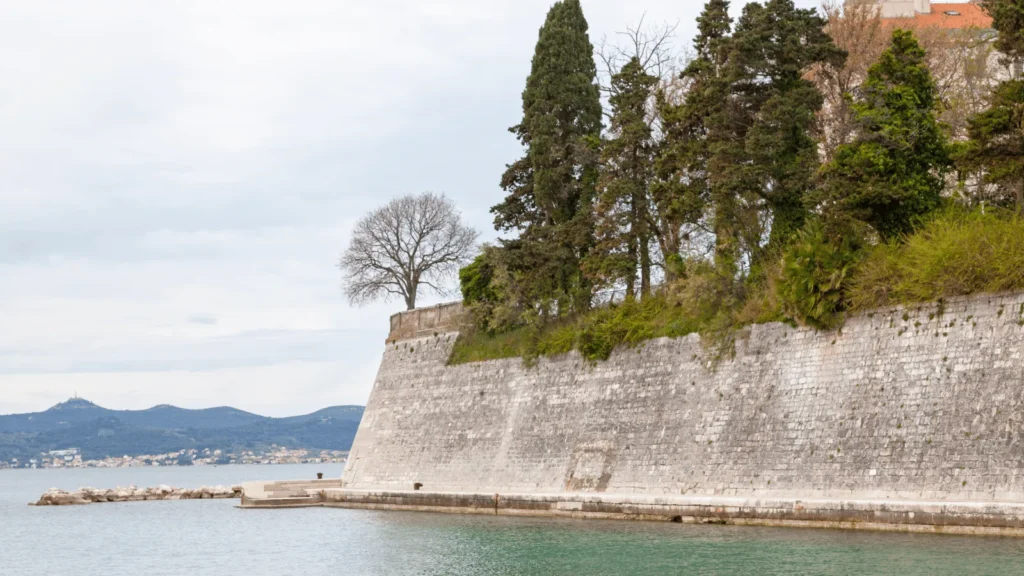
Zadar city walls, known locally as Muraj, are among the most impressive and best-preserved fortification systems on the entire Mediterranean. Officially named the Walls of Zadar Uprisings (Croatian: Bedemi zadarskih pobuna), these monumental stone fortifications encircle Zadar’s historic peninsula and tell a dramatic story of resistance, Venetian naval power, and Renaissance military engineering. In 2017, Zadar city walls were inscribed on the UNESCO World Heritage List as part of the serial property “Venetian Works of Defence between the 16th and 17th Centuries: Stato da Terra – western Stato da Mar” — alongside five other components in Croatia, Italy and Montenegro.
In this guide: History of the Walls of Zadar Uprisings | UNESCO World Heritage status | Land Gate (Kopnena vrata) | Five Wells Square and Captain’s Tower | Grimani bastion and Queen Jelena Park | Walking the walls | Practical information for visitors.
Start your Zadar journey here: Zadar Old Town – History, Culture and Adriatic Identity | Roman Heritage in Dalmatia | Musical Evenings in St Donatus Zadar.
Why Zadar City Walls Are Called “Walls of Uprisings”
Zadar’s fortifications carry a unique and defiant name rooted in centuries of resistance. The Walls of Zadar Uprisings derive from the eleven uprisings that Zadar’s citizens mounted against the Venetian Republic authorities between the 14th and 16th centuries. Each rebellion was brutally suppressed, yet the people of Zadar never stopped fighting for autonomy against the powerful Serenissima, which had governed the city from the 13th century onward after sacking and virtually destroying it with the help of French Crusaders.
This extraordinary history of resistance is literally built into the stone — the walls that defended Venice’s interests from Ottoman conquest also witnessed the defiance of the people they were meant to control. Today, the name Bedemi zadarskih pobuna honors that legacy of courage.
UNESCO World Heritage Status
On July 9, 2017, at the 41st session of the UNESCO World Heritage Committee in Poland, Zadar city walls were officially inscribed on the UNESCO World Heritage List. The decision followed six years of dedicated preparation and marked a monumental achievement for the city — only the second Croatian fortification system (after Dubrovnik) to receive such recognition.
The listing recognizes the walls as part of the serial property “Venetian Works of Defence between the 16th and 17th Centuries”, which includes six components across three countries:
- Zadar city walls (Croatia) – the subject of this guide
- Fort of St. Nicholas (Šibenik, Croatia)
- Fortified city of Bergamo (Italy)
- Fortified city of Peschiera del Garda (Italy)
- Fortified city of Palmanova (Italy)
- Fortified city of Kotor (Montenegro)
These sites collectively represent the finest surviving examples of Venetian “alla moderna” fortification architecture — a revolutionary defensive system characterized by low, thick ramparts, angular bastions that eliminated dead angles for defensive fire, and sophisticated artillery platforms that changed European military engineering forever.
Read more about Zadar’s UNESCO heritage: Zadar Old Town Guide.
History of the Fortifications
The story of Zadar’s defenses stretches back nearly a thousand years. Construction of the city walls began in the 12th and 13th centuries, when Zadar was a thriving medieval commune under Hungarian-Croatian kings. These early walls enclosed the Roman-era core of the peninsula and established the basic perimeter that survives today.
The most dramatic phase of construction occurred in the 16th century, when the Republic of Venice — facing the relentless expansion of the Ottoman Empire — undertook a massive program of military modernization across its Adriatic territories. Zadar, as the capital of Venetian Dalmatia and the largest city-fortress in the entire Republic, became the centerpiece of this effort. The existing medieval walls were reinforced, new bastions were added, and the entire defensive system was upgraded to the revolutionary alla moderna standard — a response to the destructive power of cannons and gunpowder.
Why was this necessary? The Ottoman threat was constant and terrifying. Turkish forces mounted relentless attacks on the city throughout the Middle Ages and into the Renaissance. Zadar stood as the Venetian Republic’s most important bastion on the eastern Adriatic, a city constantly under the shadow of Ottoman expansion. Without its massive walls and fortifications, the city and the entire Dalmatian coast would likely have fallen.
When the Republic of Venice fell to Napoleon in 1797, the walls lost their military purpose. Later, under Austrian and then Italian rule, the defensive system was partially modified, with some gates added and others walled up. Today, thanks to a major revitalization project funded by the European Union in 2020, the walls have been restored and opened to visitors as a walkable heritage attraction.
The Land Gate (Kopnena vrata) – Zadar’s Triumphal Entrance
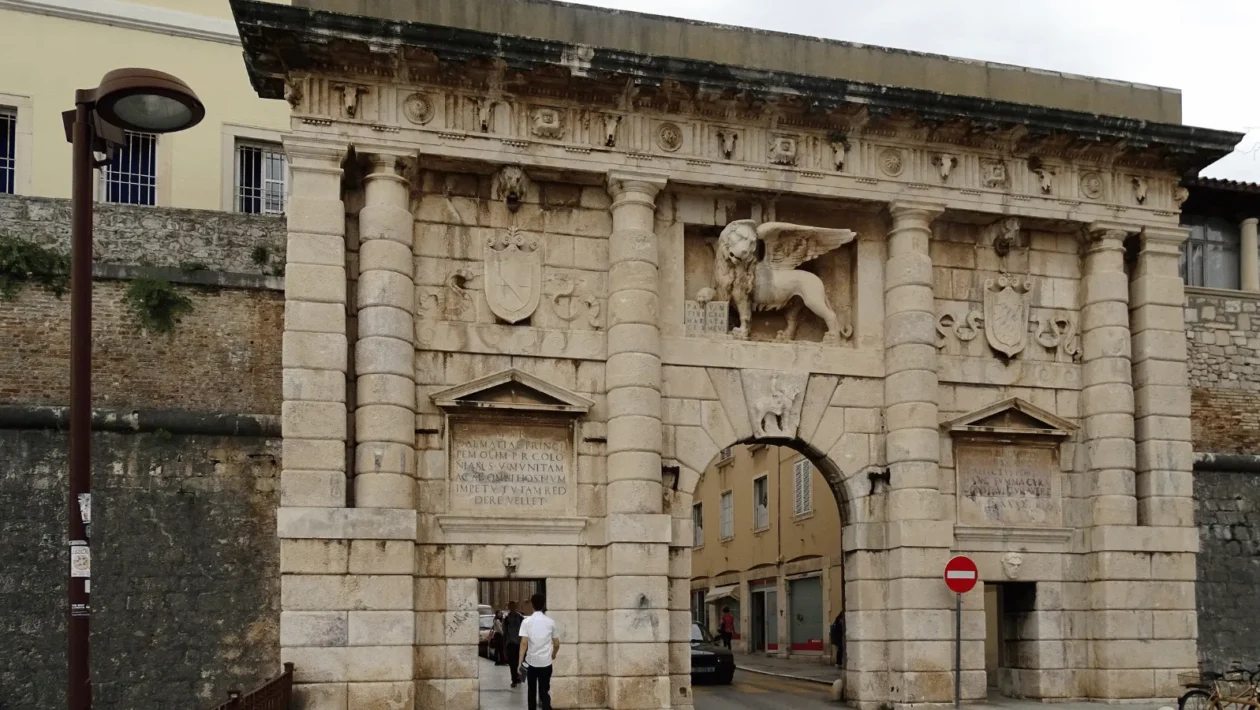
The Land Gate (Porta Terraferma in Italian, Kopnena vrata in Croatian) is without question the crown jewel of Zadar’s fortifications. Built in 1543 as the main landward entrance to the city, it remains one of the finest Renaissance monuments in all of Dalmatia.
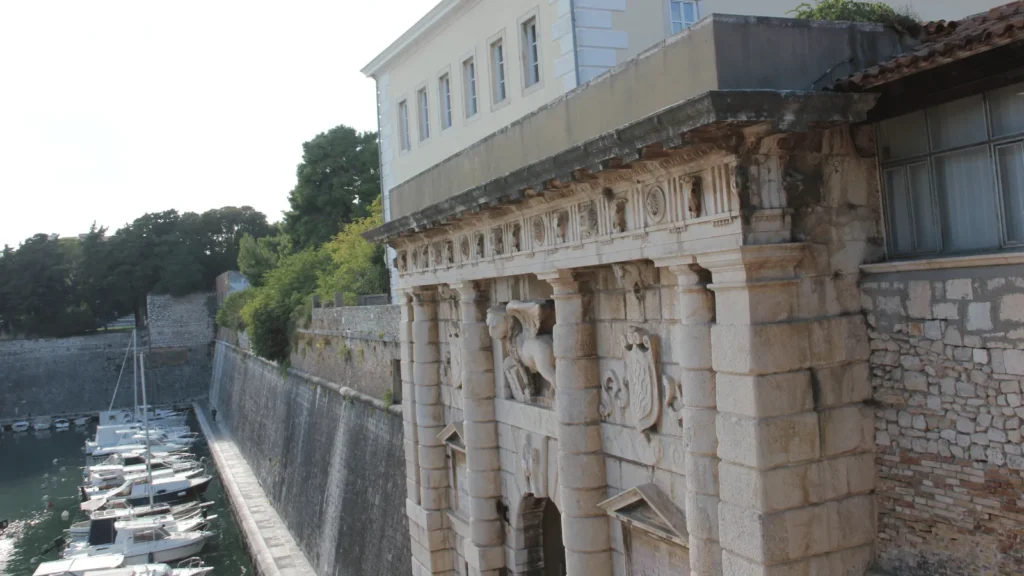
Designed by the celebrated Venetian military architect Michele Sanmicheli (from Verona), the Land Gate takes the form of a triumphal arch — a deliberate statement of Venice’s power and authority. The structure features four Corinthian columns supporting three archways: a wide central passage originally for horse-drawn carts and two smaller side entrances for pedestrians. This tripartite design, rare for a city gate, reflects the confidence of Venice at the height of its power.
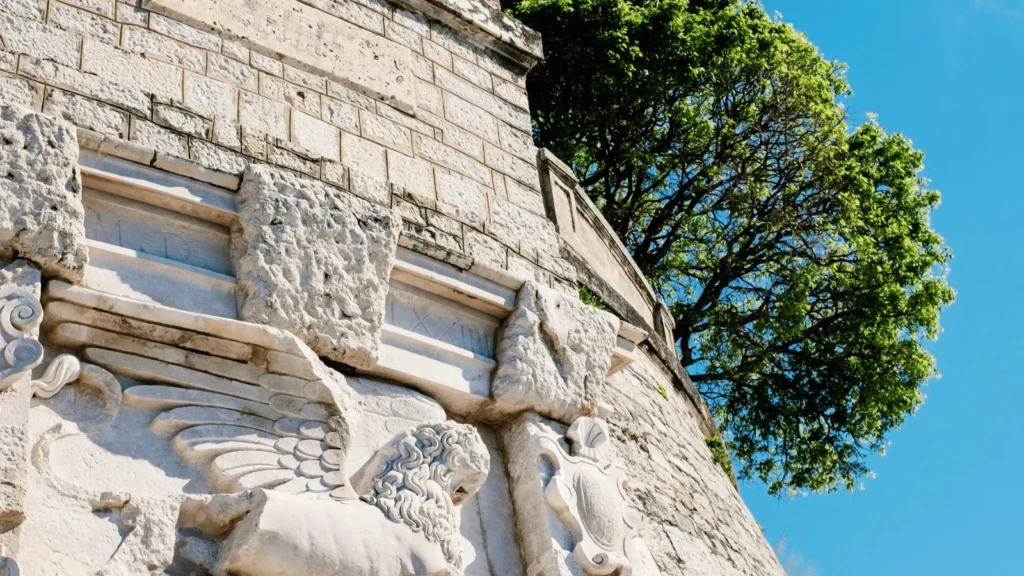
Strategically positioned by the Foša harbor, the gate’s decoration is rich with symbolism. Above the central arch stands a statue of St. Chrysogonus (Sveti Krševan), Zadar’s patron saint, whose image has guarded the entrance for nearly five centuries. Flanking him are the Coats of Arms of the Venetian Republic and the City of Zadar. Most famously, the winged lion of St. Mark — the enduring symbol of the Serenissima — dominates the facade, its open book representing Venice’s commitment to peace when its pages are open and war when closed.
Passing through the Land Gate, you step directly into the Roman Forum — an architectural journey from Renaissance grandeur straight into antiquity.
Explore more fortifications: Roman Heritage in Dalmatia — from Zadar’s Forum to Diocletian’s Palace.
Five Wells Square – Wells, Water and the Captain’s Tower
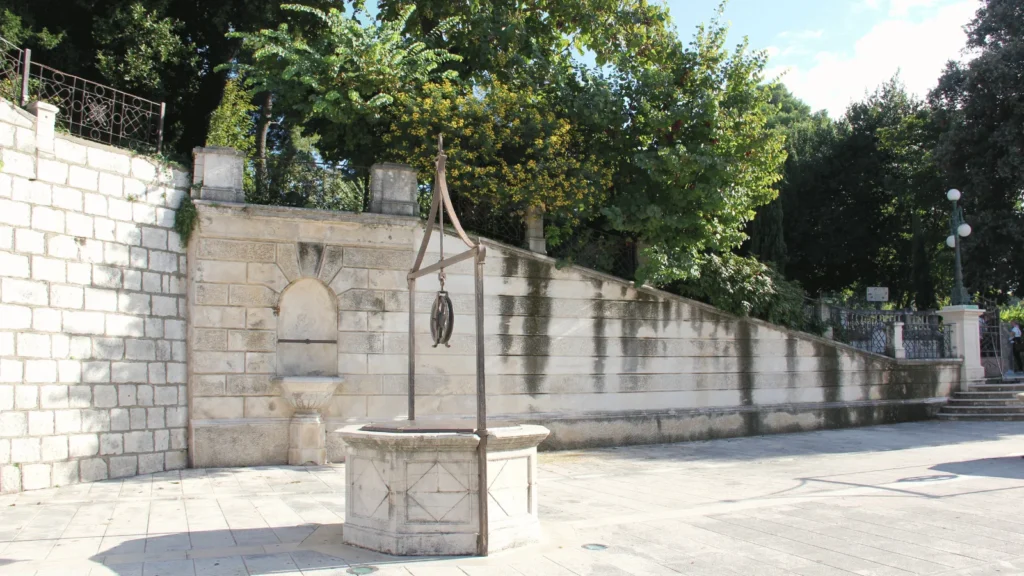
Just inside the Land Gate lies Five Wells Square (Trg pet bunara) , one of Zadar’s most photogenic public spaces. The square takes its name from five stone wells sunk into the former moat in 1574. During a period of constant Ottoman threat, the Venetian authorities built these wells to ensure a secure drinking water supply for the city in case of siege — a practical necessity that has become an atmospheric landmark.
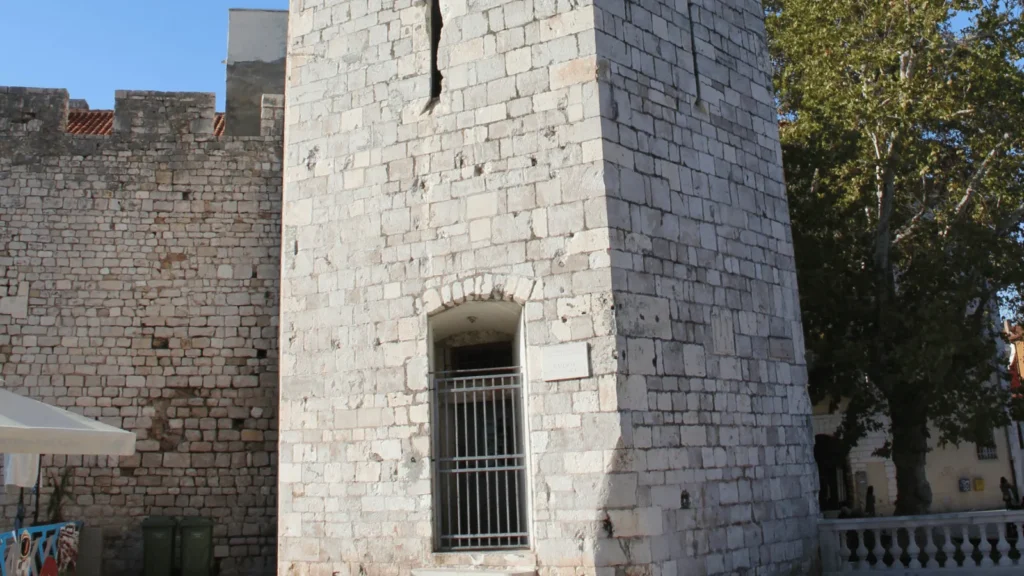
The square is dominated by the Captain’s Tower (Kapetanova kula) , a pentagonal structure that rises 26 meters (85 feet) .The tower is the sole surviving example of the ten medieval towers that once studded Zadar’s walls. Originally built in the 13th century, it was raised higher in the 18th century and later served as a Venetian arsenal. From the top, panoramic views sweep across the Land Gate, the harbor, and the red-tiled roofs of the Old Town.
The wells themselves run in a line parallel to the city walls, their deep stone mouths still intact after 450 years. The square’s inscription “MDLXXIV” (1574) carved into the walls reminds visitors of its Renaissance origins.
The Grimani Bastion and Queen Jelena Park
Above Five Wells Square, a staircase leads up to the Grimani bastion (Grimani Bastion) — the largest and most important bastion in Zadar’s defensive system. Construction of this Renaissance fortification began in 1537, following the design of architect Michele Sanmicheli (the same architect who designed the Land Gate).
Today, however, the Grimani bastion has been transformed into something remarkable: Queen Jelena Madijevka Park (Perivoj kraljice Jelene Madijevke) , Zadar’s oldest public park. The park was founded in 1829 by Austrian commander Baron Franz Ludwig von Welden, a passionate botanist and admirer of Dalmatian flora. His decision to establish a public garden on a former military structure was unusual for its time but visionary in retrospect. The park blends landscaping art with ancient architecture, offering visitors the shade of centuries-old trees and magnificent panoramic views of the harbor and the Old Town’s rooftops.
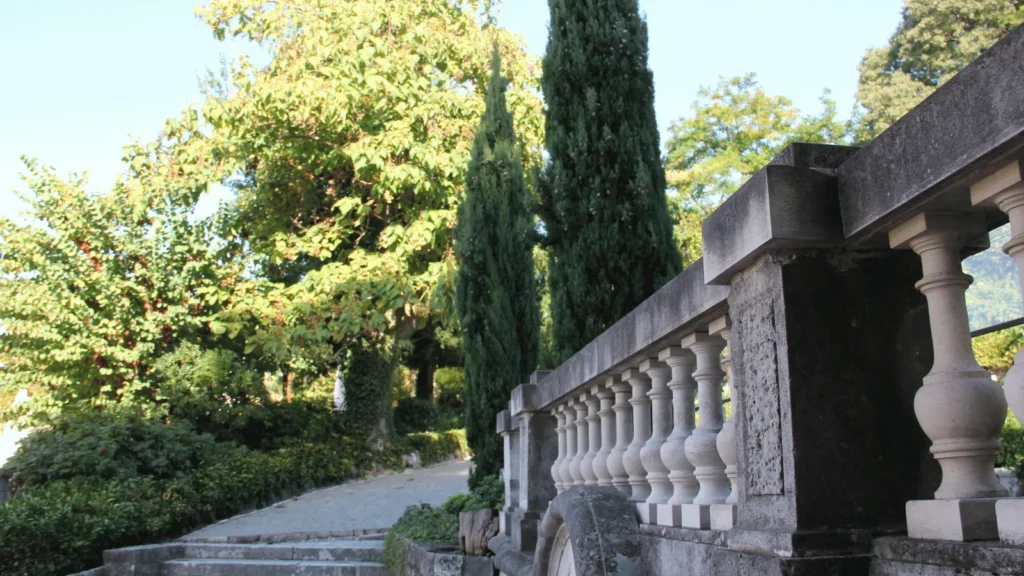
The park is named after Queen Jelena Madijevka (Jelena Madijevka) , wife of Croatian King Dmitar Zvonimir, who reigned in the 11th century. It remains one of the finest examples of converting military architecture into public green space anywhere in Europe.
Forte Fortress – The Outer Defense
While the city walls protected Zadar’s peninsula, the Venetian Republic also built an outer stronghold: the Forte fortress (Fort Forte) . Located on the mainland opposite the Old Town across the harbor, Forte was part of the broader Zadar defensive system that created a layered network of protection. Together with the main city walls, Forte fortress was inscribed on the UNESCO list as part of the same serial property.
Though less visited than the walls themselves, Forte offers a fascinating glimpse into the outer defenses that guarded the city’s landward approaches.
Other City Gates Worth Seeing
Beyond the magnificent Land Gate, Zadar’s walls feature three other historic gates, each from a different period of the city’s complex history.
Sea Gate (Morska vrata)
Located behind the Church of St. Chrysogonus between the ferry port and the market, the Sea Gate incorporates part of a Roman arch and was reworked by the Venetians in 1573 to celebrate a Christian naval victory over the Turks. A relief of St. Mark’s lion faces the sea, while the land-facing side records Pope Alexander III’s visit to Zadar in 1171. The street leading up to the gate — Aleksandrova — bears the Pope’s name.
Bridge Gate (Mostna vrata)
The newest opening in the city walls, the Bridge Gate was cut through to Narodni Trg (People’s Square) by the Italian authorities in the 1930s. Its wider, modern character reflects the changing needs of 20th-century urban traffic.
St. Rocco Gate (Vrata svetog Roka)
The smallest of the four surviving gates, St. Rocco Gate connects Three Wells Square with the harbor and is named after the patron saint of plague victims.
Walking the Zadar City Walls – A Visitor’s Guide
The city walls that remain today stretch for approximately three kilometers — much shorter than Zadar’s original circuit but still highly walkable and rewarding. A nearly two-mile loop circumnavigating the Old Town is a journey through nearly every stage of Croatian history, from Roman foundations to Venetian grandeur to Habsburg modernization and contemporary adaptive reuse.
Where to begin? Start at the Land Gate, the main entrance to the Old Town. From there, turn right into Five Wells Square to admire the stone wells and the Captain’s Tower. Climb the staircase leading up to Queen Jelena Park atop the Grimani bastion, where you can walk along the wall’s upper level with benches shaded by ancient trees and wonderful harbor views.
From the park, follow the promenade southward along the harbor-facing walls. These sections, reinforced between the 12th and 17th centuries, offer uninterrupted sea views and the cooling breeze of the Adriatic. Continue around the peninsula’s tip, passing the Sea Organ and Greeting to the Sun, then walk north along the western (seaward) wall, which terminates near the Sea Gate market. The entire loop takes about one hour without stops — allow 90 minutes with photography and breaks.
Practical tips: Wear comfortable walking shoes. Bring water, especially in summer. Sunset walks along the harbor-facing walls are spectacular and less crowded. Admission to the walls and public spaces is free, though the Captain’s Tower interior and certain sections may have limited access or seasonal hours — check at the Zadar Tourist Board office near the Land Gate.
Complete your Zadar itinerary: Greeting to the Sun — Zadar’s sunset light show.
Preservation and the Future of Zadar City Walls
Thanks to the UNESCO listing and European Union funding, Zadar city walls have undergone significant restoration and revitalization. The 2020 EU-funded project repaired damaged sections, improved visitor access, and installed interpretive signage explaining the walls’ military, social and cultural history. These improvements have made the walls accessible to pedestrians in ways that were not possible for centuries.
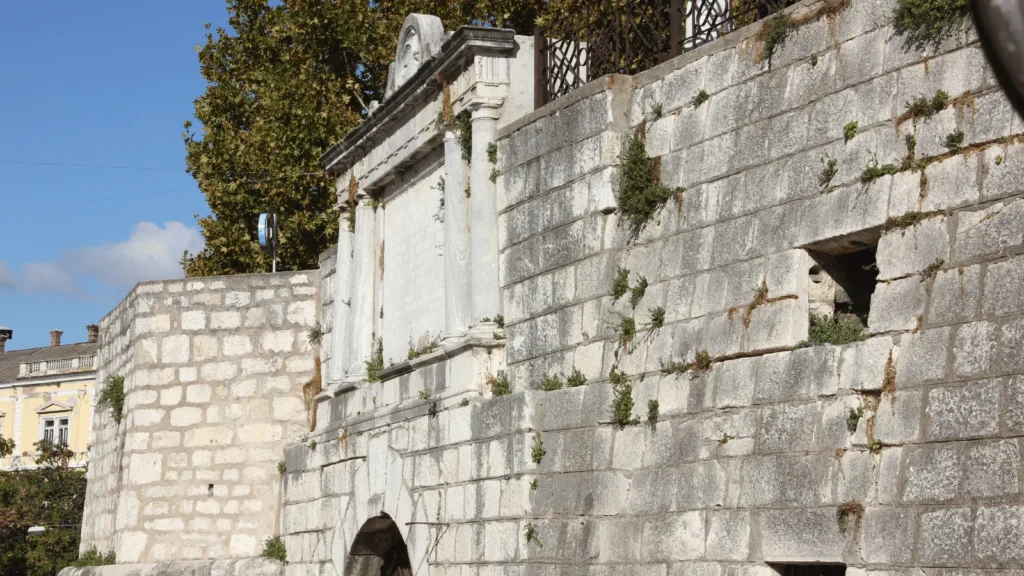
Nevertheless, challenges remain. Coastal erosion from rising sea levels, the impacts of mass tourism, and the ongoing need for maintenance of structures nearly 500 years old all require careful management. The Resilient Cultural Landscapes project, supported by the European Union, is monitoring these threats and developing adaptive strategies to protect the heritage for future generations.
Find more on Dalmatian heritage: Roman Heritage in Dalmatia.
Conclusion – Walking Into History
Zadar city walls stand as one of Europe’s most underrated yet most rewarding fortification systems. While Dubrovnik’s walls draw the crowds, Zadar’s UNESCO-listed Muraj offers a more intimate, contemplative experience — and one with an even longer history of resistance and resilience. From the 12th-century medieval foundations to the 16th-century Venetian bastions, from the eleven uprisings to the 21st-century revitalization, the walls tell the story of a city that never surrendered.
Walking atop the harbor-facing walls at sunset, with the Adriatic on one side and the red roofs of the Old Town on the other, you are literally walking through nine centuries of history. Few places in Croatia offer such a powerful, accessible connection to the past — completely free of charge, open at any hour, and waiting for you to discover.
Plan your visit: Begin at the Land Gate, walk the walls, then explore the Old Town. The stones are waiting.
Start your journey: Zadar Old Town – History, Culture and Adriatic Identity | Roman Heritage in Dalmatia | Musical Evenings in St Donatus Zadar | Greeting to the Sun — Zadar’s sunset light show.