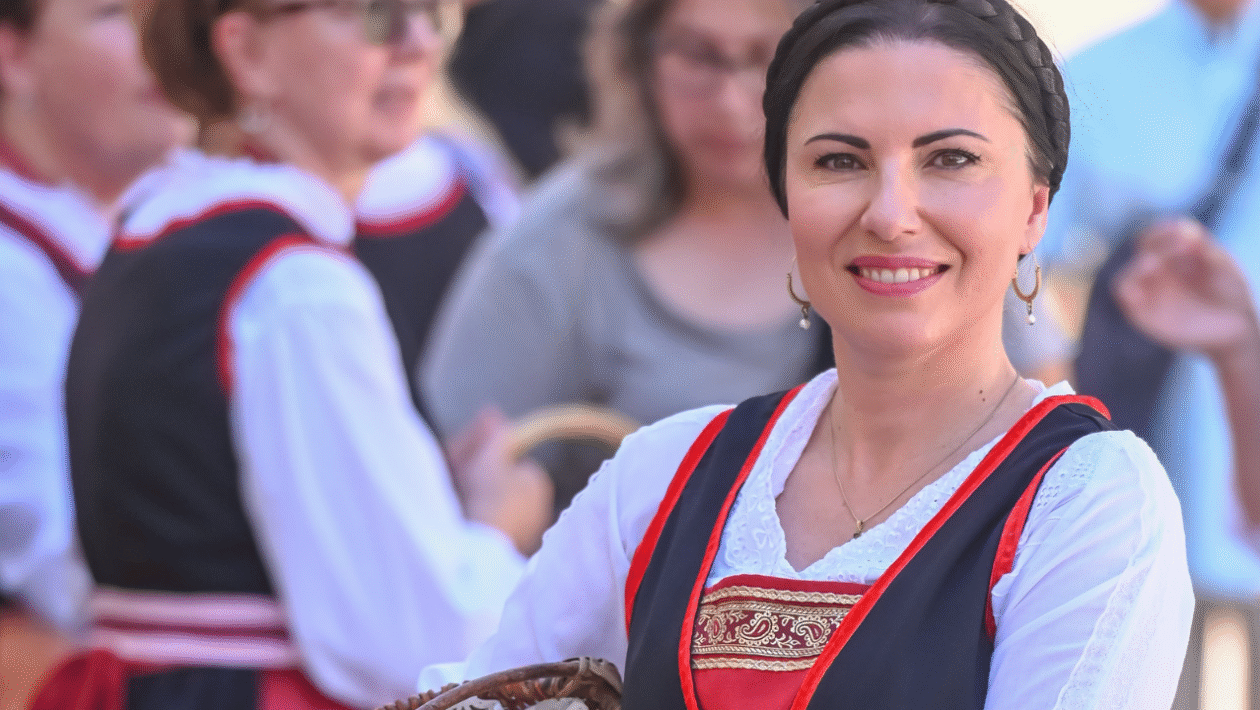
Vrgada is not a place to visit on the way. It is a destination with a soul – for those seeking more than views and rest. On this small island, just a few nautical miles from the mainland, time has not stood still, but rather – it seems – has returned to itself. Vrgada offers a rare privilege: to live in a modern way, but slowly; to be connected, but present; to work, but in harmony with nature’s rhythm. In this balance between old and new, silence and discovery, we are guided by Maja Punoš Rebić – a cultural heritage interpreter and tourist guide who leads free walking tours around the island with great knowledge and even greater passion.
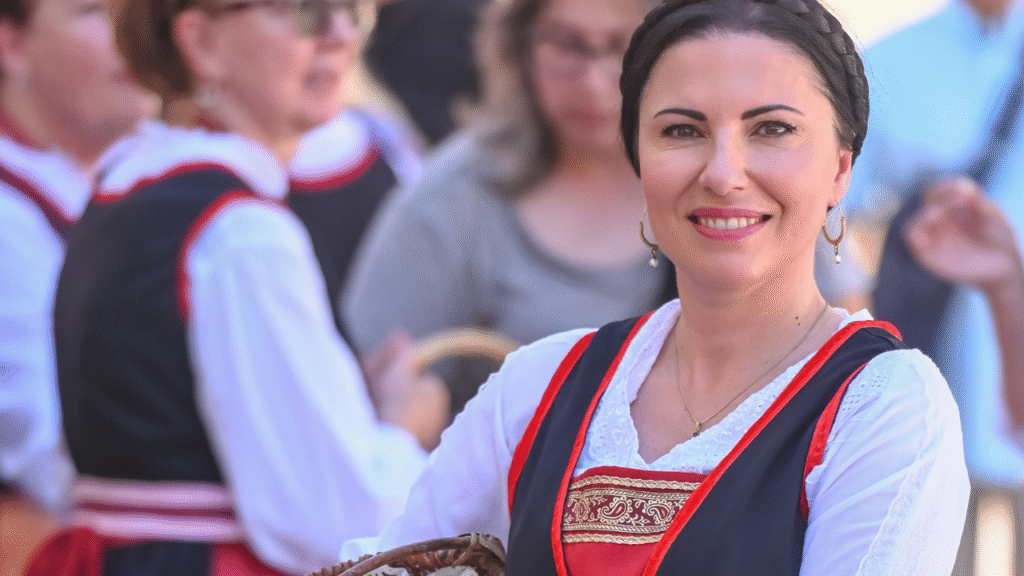
Through Maja’s stories, trails and nature, we discover layers of Vrgada that otherwise remain hidden – ones you won’t find in brochures, but you’ll take with you long after you leave the island behind. In this conversation with Maja, we discover why preserving cultural heritage on Vrgada is much more than tradition.
Can you tell us something about yourself – how would you describe yourself to those who don’t know you?
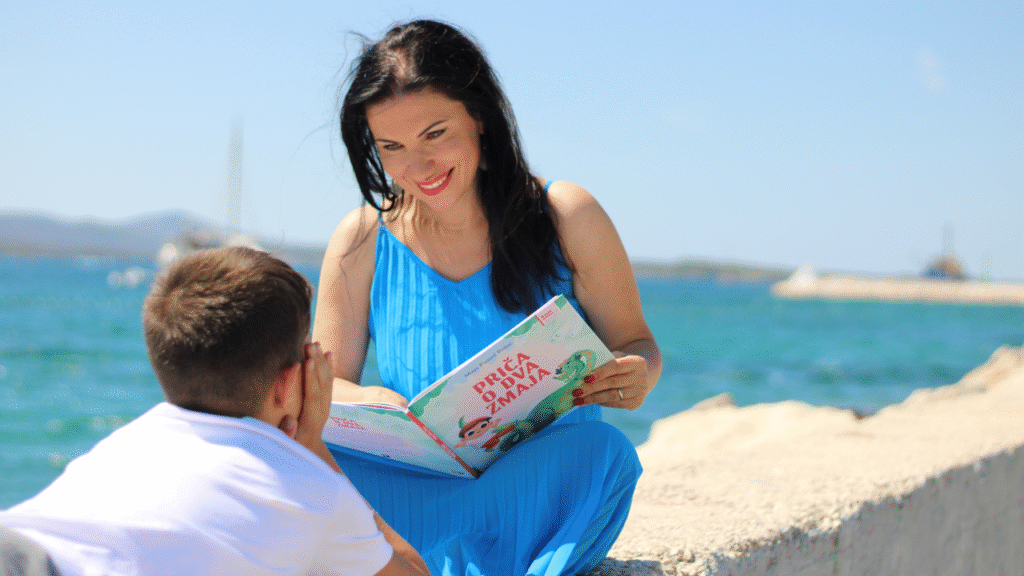
I am a lover of words in all their forms – written, sung, and narrated. I am a guardian and promoter of cultural heritage, especially of my beloved Dalmatia. I am a mother and wife, sister and daughter to wonderful, cheerful, temperamental, brave, persistent and resilient people, deserving of the fact that I can develop all my talents and skills for my own joy and the benefit of the community in which I live. I was born in Zadar, grew up in Biograd, and originate from the island of Vrgada. I lived in Zagreb and Split, and for the last 20 years, I have been working in elementary and high schools in Imotski, where I live with my family. I graduated in Political Science in Zagreb, Library Science in Mostar, obtained a tourist guide license for Zadar, Šibenik-Knin, and Split-Dalmatia counties, and a cultural heritage interpreter certificate. I wrote two therapeutic picture books for children, published by Školska knjiga, and have narrated them to thousands of children in numerous schools, kindergartens and libraries. Working with children, writing, reading, and singing in a klapa group, I rest my body and soul and draw inspiration for new projects and creativity.
How did your love for Vrgada and its heritage begin?
As soon as I became aware of the world around me. I grew up in the beautiful royal city of Biograd na Moru, but trips to Vrgada, to my grandmother and grandfather, were always a celebration for me. The island gives people peace, freedom, endless colors and sounds of nature, connection with the community, interweaving of present and history; awareness of who we are, where we come from, and where we are going. The Vrgada trinity – the heavenly blue above it, its earth and stone from which houses, dry stone walls, olive trees, beautify trees, sandy beaches, and endless sea plains around it spring forth, leave no one indifferent. Vrgada is my first and great love. A person who loves and respects their heritage and homeland is capable and ready to love other regions and climates and equally see and recognize beauty in them equally. This should be encouraged and developed in children from the earliest days.
Who or what inspired you most to engage in cultural heritage interpretation?
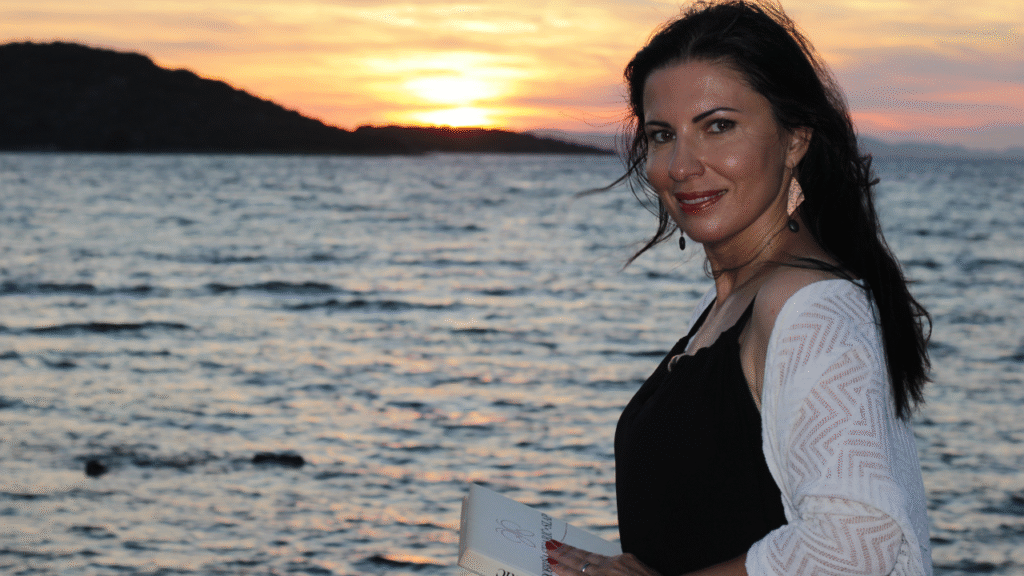
Since I have always loved writing, reading, and storytelling, and I am in love with Dalmatia, interpreting its heritage was a natural path. Everything began seven years ago when I joined the Cultural-Artistic Society “Skuti meterini” Vrgada, where I started, together with another KUD member, Nikolina Arapov, we started editing the Facebook page „Skuti materini Vrgada.” I began writing about the rich cultural heritage of our island, and she accompanied the text with her wonderful photographs. Our work and collaboration interweave perfectly because she expresses her love for the island through images, and I through words. We created numerous posts that people liked and began presenting the hidden and inexhaustible heritage treasures of this small Dalmatian Island.
How did the free walks around Vrgada begin?
Four years ago, my collaboration with the Tourist Board of Pakoštane Municipality began, especially with director Ms. Danijela Vulin, who contacted me regarding design of a modus operandi to include Vrgada in a quality and sustainable way into the tourist offer of our destination. Vrgada is historically and culturally the oldest part of the Municipality and destination. Since it is an island, its natural beauties are unsurpassed and very attractive to guests, but precisely because it is an island, it is ecologically and socially much more sensitive than the mainland. Everything planned and done on Vrgada must be done carefully, sustainably, and sensibly. The tourist offers on the mainland, for example in Pakoštane, Biograd, etc., doesn’t suit Vrgada – a measured and island-adapted approach must be implemented.
What makes the Vrgada Walk special?
Interpretive walks around Vrgada, which we started four years ago, were then a novelty along our entire coast. Only a few of my colleagues worked on similar projects. Some even did interpretive tours in costume, but for good interpretation, costume is neither crucial nor mandatory, although it brings an additional experience to visitors.
Interpretive walks are similar to classic tourist tours in that they are led by licensed guides who are expert and professional tourism workers. On such tours, you will hear all the important facts that interest you.
However, the difference is that interpretive walks “draw” visitors into the story of the destination they are visiting. It becomes their personal experience, an encounter – they identify with its stories and recognize themselves in them. An interpretive walk must inspire people, encourage them to think, leave a mark on their hearts. Visitors must carry with them a part of the soul of the place they visited. Tourist guides – heritage interpreters know how to do this, each in their original way.
I admit, it’s really easy for me to do this because Vrgada itself is my best helper in this. On my interpretive walks, every corner of Vrgada leaves visitors breathless. I just reveal those corners to them and accompany them with words.
Who are the tours intended for and when are they held?
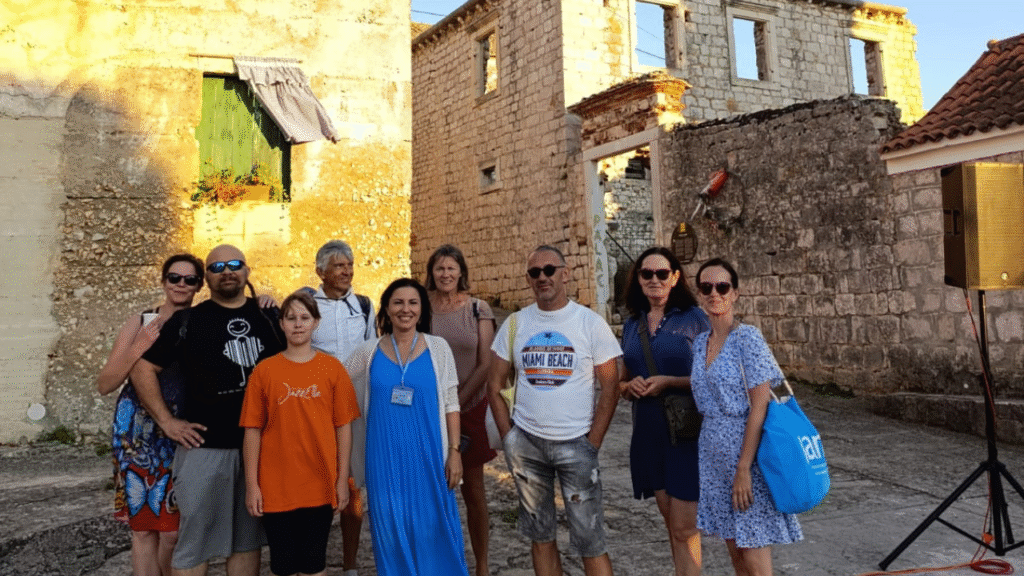
Everyone equally loves such tours. Both domestic and foreign guests. Those who originate from Vrgada and those visiting for the first time. There are children and adults on the tours. The reason for this is the way Vrgada is presented. Interpretive walks talk about the history, mentality and customs of Vrgada through stories, legends, photographs, personal experiences at the sites being talked about, meetings with the local population…
Every Wednesday interpretive walks are in Croatian, and every Thursday in English. They always start and last the same, from 6 PM to 7:30 PM, and we leave near the catamaran dock, next to the “Palmina” gallery and a location called “Vrata Vrgada” – there is an interpretation board with that name as well as a map of Vrgada.
Can you describe one tour – where do you start and what are the points you always like to show?
We visit and get to know two Vrgada churches (two of four) – the small church of Our Lady of Health and the parish church of the Holy Trinity, and listen to stories about them – when, how, and why they were built, what they hide inside; we listen to stories about original, mysterious, and mystical paintings and objects found inside. We pass through the old core of the town and listen about the life that these small courtyards and squares bustled with 50 years ago. We walk through the old town and hear about the life that these small alleys and courtyards were bustling with 50 years ago. We hear about the tradition of the island, the busy but eternally smiling life of the islanders, about the Glagolitic heritage, the specific speech of the island of Vrgada, about the Vrgada Conti (counts) and why the people of Vrgada were overjoyed when the Conti finally had to leave the island.

Do you have any anecdote from a tour that particularly remained in your memory?
On my first tours, along with Vrgada visitors, my relatives – local population, especially the older ones, followed me. I was honored by their arrival and support. When I thanked them for joining the tour, they replied, in their specific island style, that they did it only to check if everything I say about Vrgada is true. Most importantly, they approved my tour and marked it as authentic and verified.
Curiosities and discoveries for visitors
What hidden corners of Vrgada do only Vrgadans know, and you love to show to guests?
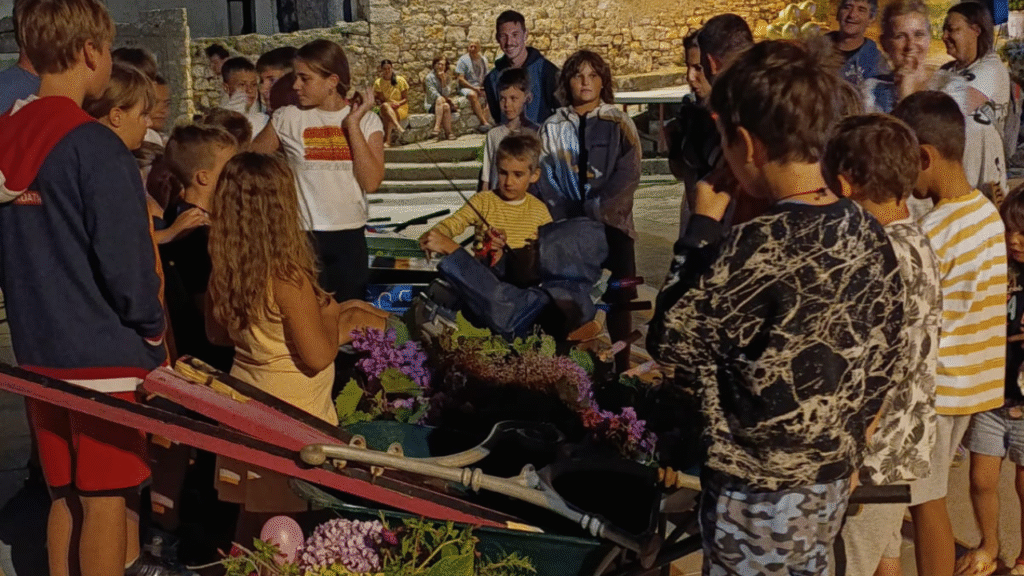
Besides cultural and historical landmarks that the island abounds with and the legends and stories that accompany their origin, our visitors also discover the traditions of the island that have been passed down for centuries and that the islanders still practice today. This refers to intangible heritage such as making St. Anthony’s Bouquets, St. Blaise Cakes, Dida from the grove (Vrgada Christmas Eve), Palm branches for Palm Sunday, the tradition of bocce ball and folk singing, the importance of the wheelbarrow in Vrgada, fig drying, and much more.
Is there a place or object on the island that carries a special legend or interesting historical story?
The story of the mystical icon, the painting of Our Lady of Health, and the Byzantine statue of St. Andrew always attract the most attention and encourage people to ask additional questions, which I always gladly answer. The remains of the walls of the Vrgada counts palace as well as those of the Byzantine military fortress on Gradina hill, without explanation and stories about the people who lived in them, are just “dead capital,” and that’s why heritage interpretation is very important. It’s precisely that “human factor,” the interpreter who is the link between cultural heritage and visitors, a person who helps them create a real experience of what they’re visiting, something that doesn’t exist in any brochure or guide.
Behind good heritage interpretation stands a person who knows the destination well, who loves their job, and who is especially motivated for visitors to carry away a beautiful experience, memory, and encounter from the place they’ve seen.
Cultural-Artistic Society “Skuti meterini” Vrgada
In what ways does Cultural-Artistic Society “Skuti meterini” Vrgada contribute to preserving the island’s identity and tradition?
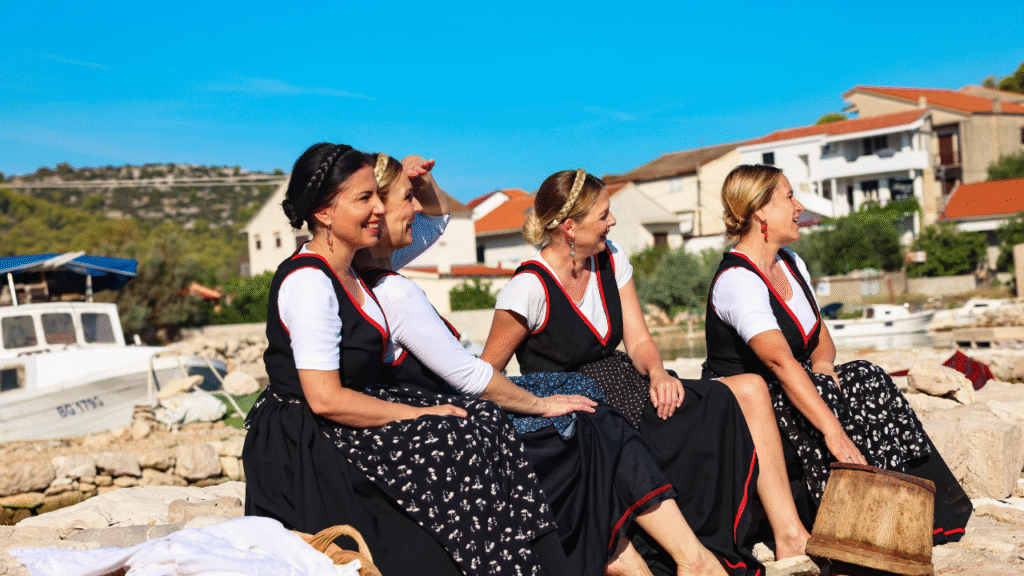
Cultural-Artistic Society “Skuti meterini” Vrgada founded in 2011, is the initiator of many actions and projects, a guardian of Vrgada heritage, and gathers only about 10 women who work diligently, persistently, and voluntarily caring for everything. The president of
Cultural-Artistic Society “Skuti meterini” Vrgada is Ms. Dušanka Arapović.
I am proud to be part of that valuable and dedicated female team. I must mention how our members are unselfishly helped by several of our male “logisticians,” mainly husbands of our members.
Throughout the year, Cultural-Artistic Society “Skuti meterini” Vrgada tirelessly works on preserving and promoting our heritage, even from afar.
I, who am the secretary of KUD and administrator of the Facebook page “Skuti materini Vrgada,” am one of several members who don’t live permanently on the island, but our beloved island is constantly in us, and we help as much as we can from afar.
We are especially proud when we put on our Vrgada folk costume, tie our colorful belt around our waist, sing and dance our Vrgada circle dance, like our ancestors.
In the music video and song “Oj, Vrgada,” which we made in collaboration with Mr. Oliver Jakovčev Berekin, you can see and hear our love for the island. If you haven’t already, look for it on YouTube.
Is there a Cultural-Artistic Society “Skuti meterini” Vrgada performance or event that you would single out as particularly emotional?
The Cultural-Artistic Society “Skuti materini” Vrgada is the main guardian of island tradition and organizer of cultural and entertainment events.
The following summer events are organized by Cultural-Artistic Society “Skuti meterini” Vrgada?
-Vrgada Užonce – on the feast of St. Anne and Joachim – heavenly patrons of Cultural-Artistic Society “Skuti meterini” Vrgada (folk and gastronomic heritage of the island is presented, a boat for visitors from the mainland is organized, and the evening is enriched with an all-night concert by some band)
-Celebration of the Assumption of Mary (after Holy Mass and procession with Mary’s statue, a cultural and entertainment program follows like for Vrgada Užonce)
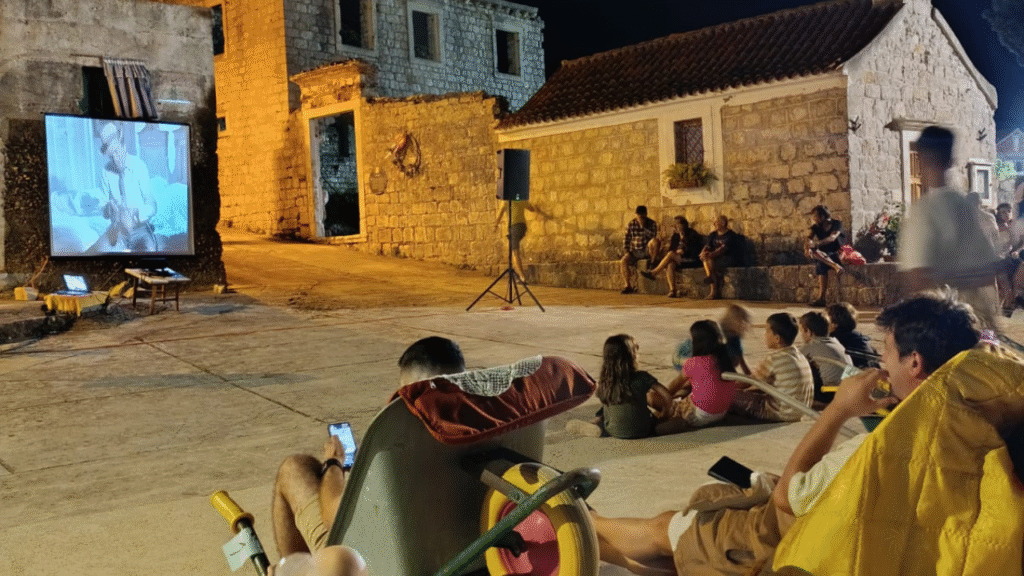
-Festival “Šjora Karijola” (evening dedicated to the wheelbarrow – wheelbarrow riding, appearance and decoration of wheelbarrows, their purposes, etc.)
-Vrgada Children’s Jobs (forgotten games are played, stories are told, and an award is given for the best young fisherman of Vrgada)
-Klapa Through the Village (promenade performance by klapa accompanied in song by the residents themselves, from the main square “Ulica” to the catamaran port “Luka”)
-La musica di notte – ambient concert by performers whose repertoire and interpretation style fits into Vrgada’s authentic Dalmatian ambiance
Traditional food
What dishes best describe the flavors of Vrgada?
Besides religious holidays, which are associated with original Vrgada traditions – specific and authentic dishes such as brudet from dried “pasovina” (shark), brudet from “ubotnica” with manistra (octopus), fried “bubice” (fried sweet pastry; elsewhere called pecipaje or mimci), Easter loaves and “turte” (a type of simple cake/biscuit without cream), and specific traditional songs sung in church and through courtyards and streets, there are numerous other events and manifestations that promote our tradition and celebrate island life.
Why visit Vrgada
What makes Vrgada special compared to other Dalmatian islands?
Vrgada is a pearl of the Adriatic. It is Dalmatia as it once was. Time hasn’t stopped on it, but people on Vrgada manage time better – they live more consciously in the present moment and are free from unnecessary habits and burdens. It enables modern people to live contemporary life within their possibilities. People whose work is related to online business can work their jobs without problems on Vrgada. The mainland is only 2-3 nautical miles from Vrgada. In summer, Vrgada is connected to the mainland with 8 catamaran lines, and in winter with 4. There is an elementary school on the island, and the nearest doctor is in Pakoštane, half an hour from Vrgada. However, despite everything mentioned, not everyone is ready to live on the island. People have become dependent on the availability of everything – now and immediately, on the comfort of mainland life, on crowds and bustle. Silence, peace, and life in rural, especially island environment disturbs many people. The reason is that when a person is surrounded by silence and calms down, they hear themselves and their thoughts, desires. This is sometimes disturbing because modern people don’t know how to establish a relationship with themselves, so they constantly surround themselves with media, sounds, images, headphones, smart watches, gadgets that direct them where and how to walk, think, and decide. They no longer trust themselves and their natural environment. They establish fewer and fewer healthy and living relationships with themselves and other people.
Vrgada offers exactly that – it returns modern people to themselves and the people around them. It returns lost peace, freedom, and community. It forces them to live in the present moment, helps them notice small things, details, and symbolism, returns them to their original nature.
“Walking Vrgada” is not just a tourist tour – it’s an invitation to connect with the island on a deeper level. Through history, song, and authentic stories, visitors have the opportunity to feel the true soul of Vrgada. Tours are held from July 16 to August 28, every Wednesday (in Croatian) and Thursday (in English) from 6:00 PM to 7:30 PM. Whether you’re visiting the island for the first time or returning again, this walk opens the door to a unique experience of Dalmatia as it can rarely be found elsewhere. For more information and announcements, follow the Visit Vrgada – Story of Dalmatia page and join this unforgettable walk through the heart of the island.